Choosing a pergola roof is one of the highest-impact decisions in an outdoor project because it controls shade, rain behaviour, maintenance, noise, and how the space feels at night. Unlike inspiration-only posts that catalogue pretty ideas, this guide is decision-first: it walks the full spectrum from open beams to fully enclosed systems, compares realistic trade-offs for Sydney, and ends with a short framework of questions you can take to an installer. If you want creative visual directions, pair this with our pergola roof ideas article; use this page when you are ready to commit to a performance strategy.
The Full Spectrum of Pergola Roof Options
At one end, open beam and slatted roofs prioritise filtered light and architectural rhythm. At the other, insulated and solid metal roofs prioritise shelter and room-like comfort. Between them sit polycarbonate sheets, retractable fabrics, and adjustable louvered systems that attempt to bridge flexibility with protection.
Most homeowners do not need the most complex system. They need the simplest system that meets their real weather and use pattern. The spectrum framing helps you avoid paying for premium mechanics when a well-detailed fixed roof would satisfy the brief, or conversely under-building when you truly need all-weather performance.
Open Beams and Slatted Roofs
Open beam pergolas are the classic shade structure: rafters with visible sky between them. They are relatively simple structurally and can look timeless with timber or engineered sections. Shade quality depends on spacing, depth, and orientation rather than on a continuous skin.
Slatted roofs increase shade density while retaining some openness. They can reduce harsh midday sun more than sparse beams but still allow rain through unless paired with removable covers or climbing plants, which introduce maintenance and pest considerations.
Best when you want lighter shade, strong garden integration, and lower mechanical complexity. Less suitable when you need reliable dry cover for furniture and electronics.
Polycarbonate Sheeting
Polycarbonate can span panels with translucency, creating shelter while preserving daylight under cover. It suits homeowners who dislike fully solid ceilings but still want meaningful rain protection when detailed correctly.
Trade-offs include glare in certain orientations, cleaning needs to preserve appearance, and acoustic behaviour under heavy rain that may not suit every household. Specification quality matters more than the material name alone.
Colorbond and Metal Roof Skins
Steel roof skins are common in Australian outdoor structures because they are durable when flashed and guttered properly. Colour choice influences heat reflection and visual integration with existing house roofs.
Uninsulated metal can be noisy in rain and warmer underneath in harsh sun unless paired with insulation, ceiling liners, or thoughtful ventilation strategies.

Insulated Sandwich Panels
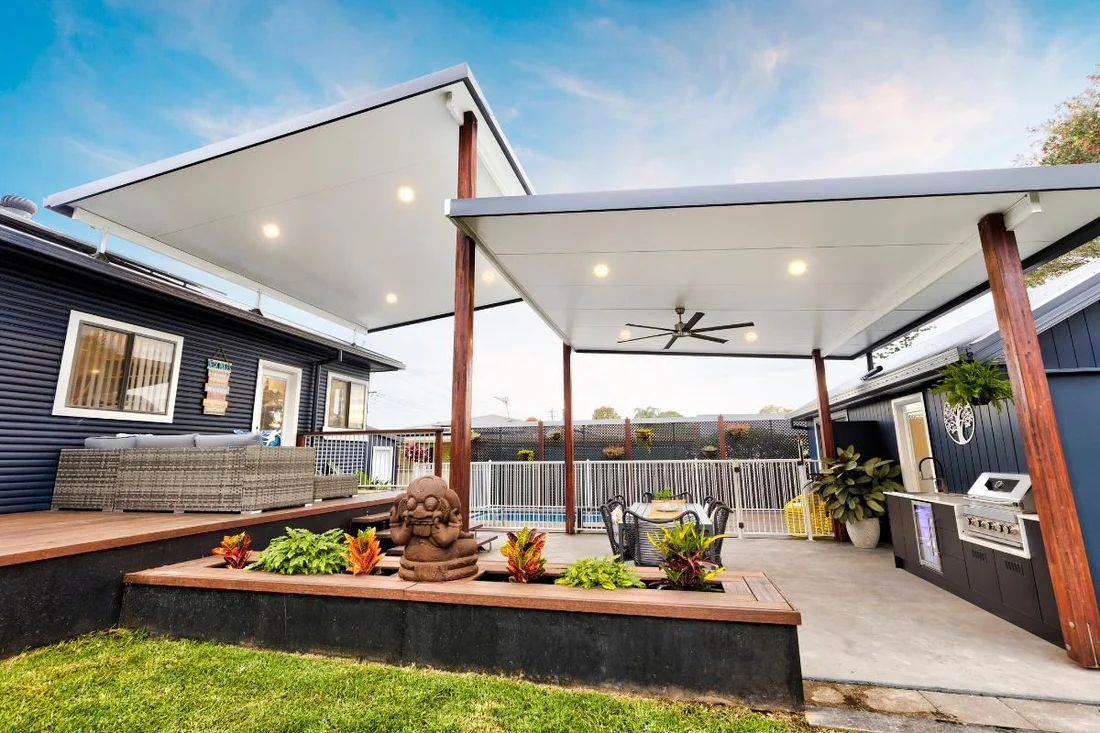
Insulated panels are strong when you want a more interior-like outdoor room. They often improve comfort underfoot and at seated head height compared with thin skins, and many users prefer the rain noise profile.
They are usually less transparent than polycarbonate, so plan lighting and interior window impacts carefully.
Louvered Adjustable Roofs
Louvered systems trade mechanical complexity for flexibility. They can be the right answer when your patio is used across seasons and you want fine control over sun and ventilation.
They generally sit in higher budget tiers and require maintenance planning for motors, seals, and drainage channels. Treat them as long-term appliances, not only carpentry.
Retractable Fabric Systems
Fabric retractable roofs can deliver wide openings and softer aesthetics than metal blades. They can be excellent for certain entertaining layouts but require honest discussion about wind behaviour, cleaning, and long-term fabric care.
They are less about structural timber expression and more about engineered tracks and tensioning hardware.
When Each Type Tends to Fit: Climate, Use, and Budget Bands
Open beams fit light-shade goals and garden-forward aesthetics. Polycarbonate fits translucency with moderate shelter. Solid metal fits durable simple shelter. Insulated panels fit room-like comfort. Louvres fit adjustable performance at premium tiers. Fabric fits selected design languages and flexibility goals when wind exposure is managed.
Budget bands are best discussed qualitatively with installers because site conditions swing costs. Expect open structures to occupy lower complexity bands and insulated or motorised systems to occupy higher complexity bands.
- Light shade and low complexity: open beams or dense slats.
- Translucent shelter: polycarbonate systems with good detailing.
- Durable fixed shelter: metal skins with gutters designed for peak rain.
- Comfort-first outdoor rooms: insulated panels.
- Maximum flexibility: louvered or retractable engineered systems.
Durability and Maintenance Compared
Open timber needs recoating and inspection for decay depending on species and exposure. Metal skins need corrosion vigilance at cuts and fixings. Motorised systems need periodic service checks. Polycarbonate needs cleaning to avoid dulling.
There is no maintenance-free roof, only maintenance-appropriate choices for your willingness and environment.
Thermal Performance in Plain Language
Insulated assemblies usually reduce heat radiating down onto people compared with thin hot skins, but ventilation and side openness still matter. A roof that traps stagnant air can feel uncomfortable even if the top surface is insulated.
If summer performance is a priority, combine roof choice with side airflow options and sensible colour selection rather than expecting one product feature to solve everything.
Drainage Considerations by Roof Type
Open beams shed little roof water as a system, but any partial infill or fabric add-on changes drip lines. Solid and insulated roofs need gutters sized for catchment and storms. Louvred roofs need engineered paths for water when blades close.
Always ask where water goes in a ten-year storm, not only in average drizzle.
Compatibility With Attached vs Freestanding Structures
Attached roofs must integrate with house weathering lines, which increases flashing complexity. Freestanding roofs must stand alone structurally and often need more visible columns or engineered beams. Roof type does not change those fundamentals, but heavy insulated roofs may push you faster toward engineered solutions.
Relative Installation Complexity
Open beam timber can still be tricky to get perfectly straight, but it is usually less coordination-heavy than motorised louvres with integrated gutters and sensors. Insulated panels require accurate spanning and weather sealing discipline.
Complexity should be judged by system requirements plus your site access, not only by product brochure thickness.
Hybrid Approaches: Combining Systems Sensibly
Some designs combine a louvered central zone with fixed perimeter cover to manage drainage or cost. Hybrids can work well when designed as a single water story, not as two systems bolted together without coordination.
If you propose a hybrid, insist on a clear diagram of water paths and maintenance access points.
Common Mistakes When Choosing a Roof
Choosing from photos without specifying performance leads to mismatched expectations. Undersizing gutters relative to catchment creates splashback stains. Ignoring interior light impacts creates winter regret. Selecting motorised systems without a service plan creates long-term friction.
Another mistake is optimising only for midday sun while ignoring low-angle glare and afternoon heat, which is often what makes patios unusable in Sydney summers.
Five Questions to Decide Faster With Less Regret
One, how many hours per week will this space be used in mixed weather? Two, is dry furniture storage a must or a nice-to-have? Three, how sensitive are you to rain noise? Four, how much transparency do you want versus room-like shelter? Five, what maintenance cadence are you willing to sustain?
If you answer those honestly, most roof categories eliminate themselves quickly. Your installer can then refine product families within the remaining category rather than presenting everything at once.
Bring photos of your patio at different times of day when meeting installers. Sun problems are easier to solve when everyone sees the same shadows.
What to Put in a One-Page Brief for Your Installer
A concise brief accelerates good advice. Include primary uses, typical group size, orientation notes, photos of problem glare times, and a ranked list of priorities such as rain protection versus winter light preservation.
Also note any future upgrades like outdoor heating, ceiling fans, or integrated speakers so fixing points and cable routes can be considered before linings close in access.
Finally, list constraints you already know: pool proximity, tight side boundaries, heritage overlays if relevant, and any council correspondence you have started. Professionals solve faster when they see the whole context early rather than discovering constraints after design lock-in.
Key Takeaways
- Roof choice determines shade quality, rain protection, maintenance, and acoustic behaviour under storms.
- Open beams, polycarbonate, metal, insulated panels, louvres, and fabric each occupy different performance niches.
- Drainage design must match the roof type and storm intensity, not only average rainfall.
- Attached projects add flashing complexity; freestanding projects add structural independence demands.
- A five-question framework cuts option overload and aligns budget with real usage.
Frequently Asked Questions
Ready for your pergola project?
Get a free quote and practical guidance from experienced pergola builders serving Sydney.
Get a free quoteRelated Posts